Tuesday, April 4, 2017

U.S Student Mobility- Studying Abroad in Spain

Spain: General Information


                  Spain is a country located in the Iberian Peninsula and it’s made up of 17 autonomous communities and two autonomous cities. Spain’s neighboring countries are France (north), Portugal (east), and Morroco (south). The official language is Spanish and their currency is the Euro, as the country is also part of the European Union. Spain’s capital and largest city is Madrid and there is a total population of 46,423,064 habitants. Spain is a country that is rich in history, culture, gastronomy, etc. 

Studying abroad programs in the United States

                    It is a very frequent practice for U.S. students to decide to study abroad for a semester or a year. As it can be seen in the statistics below, 289, 408 U.S students, in the years 2012/13, decided to study abroad. From those, 60% percent preferred a short-term duration, 37% mid-length, and only 3% long-term. The three most preferred destinations are Europe with 53%, South America with 16%, and Asia with 12%. Most of the American universities offer different programs for studying abroad, as many of them have relationships with other universities in other countries.  For example, in many cases, if a person studies science related subject, it is possible he/she to take art classes in another university (suggested by the primary university). The programs for studying abroad vary according to the age and time interval that the student prefers. There are high school programs, which offer the students to switch school in another city, country, or continent. For the university students, there are certain programs for internship, volunteer, teach, intensive or normal learning, and full degree for studying abroad. According to a research from 2016, 96% of students feel that the experience helped them mature, increased their self-confidence and 82% reported that it helped them develop a more sophisticated look of the world. (Kinloch, 2016) The cost of this experience is strictly dependent on the program that the student is attending and the university he/she is currently studying in. Based on that, the cost can vary, but for the years 2012/13, the approximate cost was 17,785$. This expense might or might not include the housing because some programs require the students to find their own apartments in the city that they are going to live in. If the cost is too high for some people, there are scholarships sorted into several categories. The first one is merit-based. This means that financial aid is only going to be based on the student's academic, athletic, artistic, or other abilities, in addition, extracurricular activities are also taken into consideration. The second category is student-specific scholarship meaning that it is defined based on the student's gender, race, religion, family and medical history. The next one is destination-specific. Here the sponsor of the scholarship is the government and so it is given to the student who plans to study in a particular country. The final two are the program-based and the subject-based, which depend on the program and the subject that the student plans to choose.
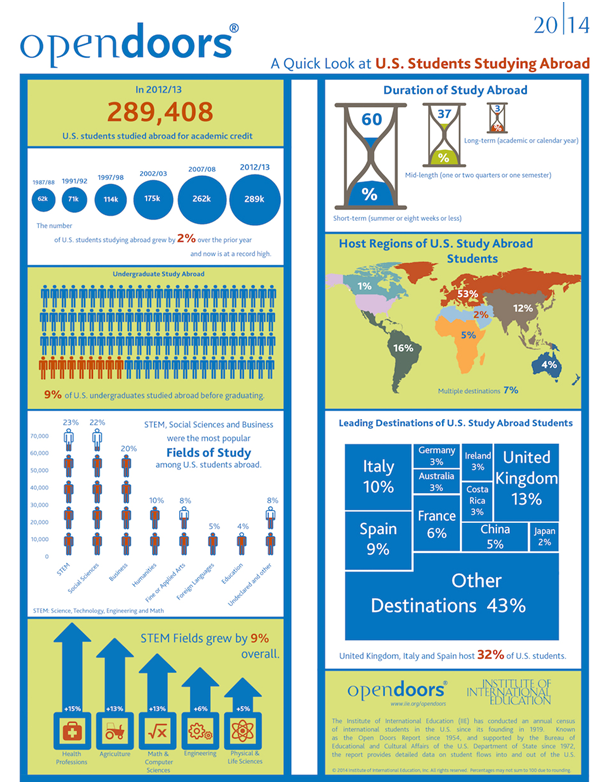
 

Spanish students study abroad vs. U.S students study abroad

               Many Spanish students decide to study abroad for the whole undergraduate and graduate course. Their application does not differ from the standard one. It includes the diploma with the proper GPA and based on the university and the country: SAT, TOEFL, IELTS, etc. On the other hand, studying abroad for a semester or a whole year is not that popular among the Spanish students as it is in the U.S. Most often, only certain subjects and courses have the opportunity for studying abroad. If the university has the program, then the other problem is the limited number of countries, which offer the course. Another issue that can stop some of the students is that sometimes in order to go studying abroad, they should have something like a gap year, and thus from studying 3 years undergraduate, it becomes 4 years total. For the students who need extra help with this process, there are special organizations and institutions that provide more details. Some of the more famous ones are API, CEA, ISA, etc. The cost of studying abroad will again depend on the university the students is currently in and on the program that he/she has chosen. Scholarships are not so widely given and usually based on the financial state of the parents and on the academic abilities of the student.

Studying in Spain

                According to the website iie, in 2014/2015 about 28, 325 U.S students participated of a study abroad program in Spain, leaving Spain as the 3rd most popular country to study abroad  (after U.K and Italy). In Spain there are five types of study abroad programs offered by Spanish Universities in terms of duration, (1) year, (2) semester/trimester, (3) summer, (4) intensive month, and (5) J-Term, and the main cities that provide these programs are Barcelona, Bilbao, Granada, Madrid, Malaga, Salamanca, Santander, Sevilla, and Valencia, with the top universities to study abroad being the Universitat de Barcelona, Universitat Autònoma de Barcelona, Universidad Autónoma de Madrid, and the Universidad Complutense de Madrid. For American students to study abroad in Spain, they need to obtain a Visa that will certify the longevity of their program and their American passport. As explained earlier, some programs might include the student’s housing in the tuition, but some might not, therefore, students should arrange their housing before traveling to the country.


              Spanish universities provide three different types of degrees: Grado, Másters, y Doctorados. In addition, Spanish universities are very flexible when it comes to recognizing degrees and courses from other countries. Finally, Spanish universities offer various scholarships and financial aid for non-Spanish students to study abroad. In terms of tuition, these might vary from university to university and each program might include different aspects such as housing, meals, trips, etc.


Syracuse University’s study abroad programs

            For the purpose of this blog post we will analyze the different programs in Spain that the office of Study Abroad in Syracuse University offers. The university offers both summer (6 weeks) and semester long programs in Syracuse University Center in Madrid, but it also provides the opportunity to attend the Universidad Autonoma de Madrid and complete a program that is recognized within Syracuse university. Some of the courses available are history, Spanish, middle eastern studies, latin American studies Mass communications, Business, Economics, etc., in addition to the opportunity to complete an internship for credit hours (depending on the major). The tuition cost varies depending on the duration of the program, where semester long programs cost the normal Syracuse University Tuition and summer programs cost between $5,528-8,996 depending on the amount of courses being taken. This costs includes housing, meals, and educational trips; some courses might take an extra fee depending of the nature of such class.
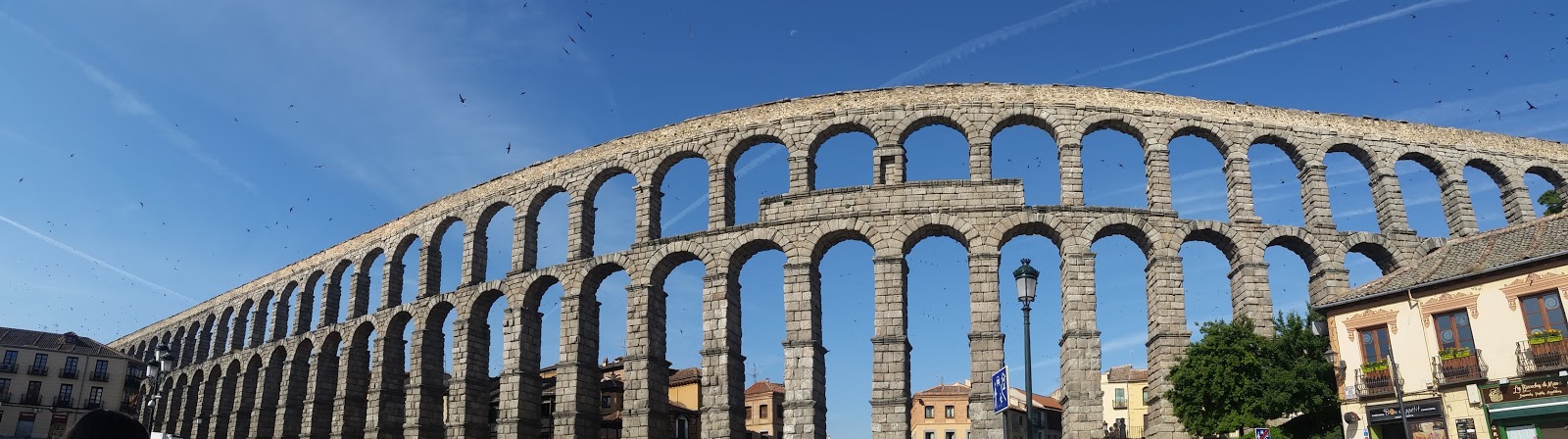

Experience Studying abroad in Spain

                  As a U.S student who studied abroad in Spain, I can say that being in Spain has been the most rewarding experience of my life. Every aspect from my host mom, the food, my Spanish professors, and just the Spanish culture in general made me feel welcome in a culture where I already have a historical connection. Although I studied in the Syracuse University Madrid Center, my professors were Spanish and the classes were given in Spanish. As part of the program, I participated of various educational trips where we would explore a city with some professors.


                    Since I participated of the summer program, which is only six weeks, I decided that I wanted to explore the Spanish culture to it’s fullest and that I would only travel within the country. By doing this, I acquired a good understanding and appreciation for the Hispanic culture. I was able to travel to Madrid, Toledo, Segovia, Barcelona, Sevilla, Córdoba, Granada, and Valencia, and understand how different every city is from each other despite it’s closeness and their shared main culture.     
                   
                      The courses that I decided to take were not related to my major, but still filled my requirements to graduate. These two courses were: Pop Culture in Spain and Art, Architecture, and Cities in Spain. These classes and my weekend adventures were the perfect combination to make my study abroad experience memorable. I was able to integrate into the Spanish culture and learn about things such as it’s history, food, and customs.         


References


 http://blogs.voanews.com/all-about-america/files/2014/11/Infographic-IIE-Open-Doors-2014-US-Study-Abroad.jpg

US Student Mobility - Studying Abroad in Italy

Italy
Italy, also known as the Republic of Italy, is located in Southern Europe, and includes the territories of the two biggest islands in the Mediterranean Sea- Sardinia and Sicily. The country shares borders with France, Switzerland, Austria, and Slovenia. While having quite a lot of neighboring countries, Italy is also surrounded by the Adriatic, Ionian, Tyrrhenian, and Mediterranean seas, which was very essential in the country’s early history due to the easily established trade through sea routes. Moreover, such a favorable location allowed not only for the exchange of goods, but for the fast spread of ideas, religious beliefs, and other movements, such as the Renaissance or the Enlightenment.
However, because of the advantages the territory provides, Italy has been under the control of different foreigners, such as France, Spain, and others, but was finally able to gain independence after many unsuccessful attempts in 1861. Although the country fought on the losing side in the World Wars, and was under the strict totalitarian regime of Mussolini, its economy managed to overcome most of the damage, leaving Italy as a quite rich, strong, and stable nation even nowadays.

Politics in Italy
Later, in 1946, the monarchy was abolished thanks to a popular referendum, which resulted into Italy becoming a democratic republic in 1948, meaning that the power is separated in between three branches. These are the Legislative power, which is responsible for the writing and accepting of all laws, the Executive power, which is responsible for the government, and the Judicial power, which accounts for the control in the country. However, all branches help with the shaping of the education.

Education in Italy
       Education has been available in the area of Italy since early ages. The oldest university in Europe is the University of Bologna, established in 1088. Another old university is the University of Padua, founded in 1222. However, schools were mainly private and only for children from the ruling class with better social status and more money. Because of this, a large amount of the population was left uneducated and illiterate.
       In the beginning of the nineteenth century, the rates of illiteracy were even greater, especially in Southern Italy, and Sicily more particularly. The first attempt for public education was in 1859 when the government issued a law that obligated all children to go to elementary school, with the first four years being free. Rates of illiteracy began to decrease, but that was still not sufficient enough. About 40 years later in 1904, another law was issued. Law 407 made it mandatory for children through the age of twelve to attend school. Moreover, as the country was becoming more industrialized, the government realized people needed to be prepared for jobs as well so they introduced something called "vocational training". Vocational training prepared individuals for the work force by providing them with knowledge in crafting, trading, and others. A few years later, in 1923, sixth, seventh, and eighth grades were separated from the elementary school and branched off into the so-called "technical schools". Elementary schools were divided into two parts: three lower grades and two upper. Meanwhile, kindergarten did not become an official grade until 1986.
       Another important point that should be mentioned is that during Mussolini's Fascist Party, even though media, teachers, and children were manipulated as victims of propaganda, literacy greatly increased. This was because although Mussolini wanted to keep everyone under his control, being an extreme nationalist, he was a strong advocate for his country's history and encouraged all students to learn history and critical inquiry.
       After the end of Mussolini's dictatorship, the country needed a strong economy in order to regain stability and power. This promoted the further development of industry, with an establishment of more schools, universities, and other education institutions.
       Nowadays, the Italian education system has divided classes into a few categories. There is Primary school, which is attended by students between ages six through eleven. Until 2004, in order for students to go from Primary school to Secondary school, they had to complete a standardized test in both written and spoken Italian language, and math. Now, student can directly enroll in middle school at age eleven and after they complete primary school. From age eleven until nineteen, students attend Secondary school. Secondary school is divided into two levels - lower (Scuola Media) and upper (Scuola Superio). Lower level Secondary school is also known at middle school, which is meant for student from ages eleven to fourteen. Upper level Secondary school is for students from ages fourteen to nineteen. For upper level Secondary school, students decide between a liceo (similar to British grammar school) or instituto (vocational) depending on which subject they want to stress. In total, there are seven kinds of secondary schools throughout Italy - classical high schools, scientific high schools, fine arts high schools, teacher training schools, artistic schools, technical institutes, and professional institutes. Graduating from each of the following provides the student with a diploma, which one can use to further their education. For example, continuing onto a Tertiary School, or in other words, a university. Italian universities generally follow the classic tertiary standards of education, meaning they include courses for bachelor degrees, 1-year and 2-year master degrees, and doctorates.


Grading System
       There is little difference in the grading system, depending on the level of education a student is in. In primary and secondary schools the grading system goes as the following: 
While in universities, a grade of “D” is added:
Some schools and universities are influenced more or less by the American grading policy of using percentages, and the grades go as the following:
       Finally, in some schools the grading system is in letters, similarly to most American Schools:

Admission Requirements for Citizens
       Although every university may have its own admission requirements, there are some more general requirements that apply to most, if not all, universities. Some of these requirements are:
  • Secondary School Diploma, obtained after at least twelve years of schooling, when applying for an undergraduate course.
  • Bachelor of Science or equivalent, when applying for Masters programs.
  • Masters Degree, when applying for doctoral programs or medical specialization schools.
Admission Requirements for non-Citizens
  • European citizens, and non-EU citizens, resident in Italy with a current, valid residence permit, and natives of Iceland, Norway, Switzerland, Lichtenstein, San Marino can apply directly to the Universities, are included in the same ranking lists of Italian citizens in case of admission test, and are not required any specific language competence.
  • Non-EW citizens and residents abroad must submit a pre-application request to the Italian Embassy or Consulate in their country of residence, are included in reserved ranking lists in case of admission tests, and unless differently specified or exempted, must pass an Italian language competence test before enrolling.
Popular Fields of Study
       Italy is considered one of the cultural capitals of the world. Italy is the homeland of some of the most famous artists, architects, poets, sculptors and writers, such as Leonardo da Vinci, Botticelli, and Dante Alighieri. When studying abroad in Italy, your learning experience is not simply confined to the classroom because Italy is technically an open-air museum. Anywhere you go, you are enriched in the countries culture and history that contribute to your knowledge gain.
       Because of the rich culture of the country, some of the most popular fields to study in Italy are humanities, arts, fashion design, and architecture. Depending on what field of study you want to pursue, it is most beneficial to choose your exact destination to amplify your learning experience. For example, the best place to study fashion design would be in Milan, the fashion capital of the world. Or if you want to study architecture, the best place to do so would be in Florence. 

Positives of Studying Abroad in Italy
       Second to the United Kingdom, Italy, France, and Spain are the second most popular destinations for students to study abroad in. Clearly, Italy is a wonderful destination to study abroad. Not only will you gain extensive knowledge in your field of study, but you will enhance your cultural awareness and intellect. Choosing to study abroad in Italy will be an extremely positive experience because of the friendly people, superb cuisine, unique land and seascapes, and unparalleled artistic and historic sites. 
       Additionally, because Italy is centrally located in Europe, it is easy to travel to surrounding regions as well. Because of this, you can further continue your cultural studies and knowledge gain just by seeing more of the world. Lots of the students I talked to about their experiences highlighted this as a huge advantage. Some spent Saint Patrick's Day in Ireland, some traveled to Germany for Oktoberfest, and some went on weekend trips to see the Eiffel Tower in France.

Negatives of Studying Abroad in Italy
       Based on the personal experience of those who have studied abroad in Italy, the number of negatives nowhere compares to the number of positives of studying abroad in Italy. However, there are challenges that students from other parts of the world will inevitably face. Because of the rich culture of the country, it's citizens take a lot of pride in all that includes. The language barrier is most commonly the largest challenge for foreigners. Natives do not adjust their language around tourists/visitors, so you will have to learn to adjust your own language around them. In addition to feeling out a new place and a new way of living, difficulties in communication are most likely to be your biggest struggle. Other than that, many individuals look back on their Italian Study Abroad experience as one of the most fulfilling, eye-opening, and valuable experiences they've had.

Student Experiences

  • https://www.youtube.com/watch?v=cUeDeFdzVVc
  • https://www.youtube.com/watch?v=B00k91sdlzs
References
  • https://www.quora.com/What-are-the-disadvantages-of-studying-in-italy
  • http://www.mastersportal.eu/articles/1226/popular-study-programmes-in-italy.html
  • https://www.studyabroad.com/in-italy
  • http://studiesabroad.com/programs/country/italy
  • http://www.lonelyplanet.com/maps/europe/italy/
  • https://www.britannica.com/place/Italy/Government-and-society
  • http://education.stateuniversity.com/pages/714/Italy-HISTORY-BACKGROUND.html
  • http://www.classbase.com/countries/italy/education-system
  • http://www.classbase.com/Countries/italy/Grading-System
  • http://www.unimi.it/ENG/admission/29528.htm
Bulgarian Partner's Video
  • https://wetransfer.com/downloads/7e97821d3a0e6e868ed3400cb45e3fc120170404182639/ed343c