Tuesday, March 7, 2017

The Politics of Refugee Education and Inclusion in Greece by Julia Sarna and Lora Dobreva


The Politics of Refugee Education in Greece by Julia Sarna and Lora Dobreva


History Of Greece
Greece is a country in South Eastern Europe, which is bordered by the Mediterranean Sea in the south and the Ionian Sea in the west. It’s border countries are Albania, Bulgaria, Turkey, and the Republic of Macedonia. Greece shares maritime borders with Cyprus, Egypt, Italy, and Libya. The capital is Athens. Greece’s population is pretty low compared to other nations, including the United States, with a total of 10,722,816 people. The Origins of Civilization occurred between 3200-1050 B.C. The Greek government was a parliamentary republic. The first great civilization in Greece was the Minoan culture, which originated on the island of Crete around 2000 B.C. During ancient times, the country was divided into city-states, which were ruled by noblemen. The largest were Athens, Sparta, Thebes, and Corinth. Each state controlled the territory around a single city. They were often at war with each other. In modern times, family life is a very important part of life in Greece. Children often live with their parents even after they get married. Greeks live long lives and it is thought that their diet of olives, olive oil, lamb, fish, squid, chickpeas, and fruits and vegetables kept them healthy.  


Refugee education across the globe


Education is a basic human right as noted in the 1989 convention on the rights of the child and the 1951 Refugee convention. Additionally, UNICEF released a quote saying, “Education is a fundamental human right: Every girl and boy in every country is entitled to it.”  Filippo Grandi is the U.N. High Commissioner for Refugees. Education is very important and without it these children could be put at risk. The current refugee crisis is as bad now as it was in WWII. There is limited access to education for refugee kids. Worldwide, refugee kids are five times more likely to be out of school than non-refugee children. 50% of primary school aged refugees attend school, whereas only 22% of secondary aged refugee kids attend school and only 1% of refugees attend college . The number of refugees attending school keeps decreasing.  The problem is that children leave behind their education as their families leave their homes because of war or political insecurity. "Education enables refugees to positively shape the future of both their countries of asylum and their home countries when they one day return". However, not all refugees do  return to their home country. Two problems with providing refugees with an education is  a lack of funding and an expanding population. The population of school age children  worldwide grew by 30% in 2014. Since there is a growth in population it requires teachers to get an extra 20,000 teachers.  Less than 2% of humanitarian aid goes towards education, which is not nearly enough to give these children proper education. Education is the key to brighter futures for refugee children, as  “Education is one of the few opportunities we have to transform and build the next generation”

Why people are resistant to refugees

Not everyone is okay with the fact that refugees come into their country and take it over, because some fear the risk of sickness, others feel like it makes an area look dirty and some say because it causes theft. Refugees would stay in makeshift shelters outside the walls of a Greek castle that decades ago provided sanctuary to refugees like them . Some aid workers and officials say attacks have been orchestrated by a far-right anti-immigrant group that advocates “clean ethnic states.” Meanwhile, some residents say that the attacks came after refugees and migrants broke into local stores, and that there has been an increase in vandalism and robberies.
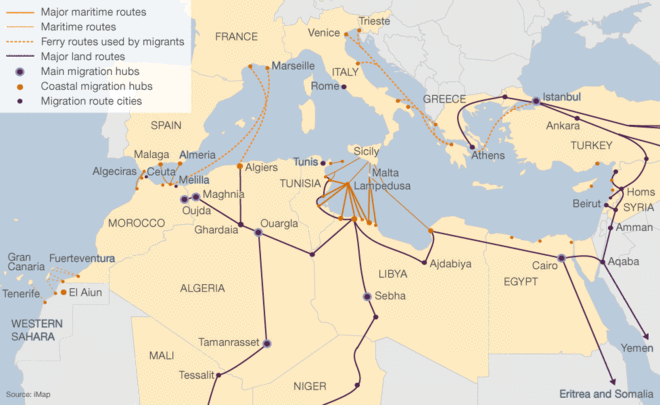
The Greek government has begun a pilot program to educate refugee children stranded in the country, as nations along the migrant trail which refugees follow, as shown in the photograph across Europe and surrounding areas, have closed their borders to refugees. It is estimated there are more than 20,000 children in refugee camps in Greece. The plan is being resisted by some Greeks, who say they worry about refugees carrying infections and also about the cultural change the plan might bring.
Refugees in Greece


One of the most commonly discussed topics in the recent years is that of refugees. These are people who are forced to leave their country, so to escape war or persecution. They are protected by international laws, and shouldn’t be returned to places where their safety is at constant risk. Currently there are more than 60,000 refugees that have been forced to leave their country and that have sought asylum in Greece, with over half of them being women and children. Around 1.3 million refugees have travelled through the country in their search for safety, most of which arrive by sea from Syria, Afghanistan and Iraq. Their trip to Europe is often a dangerous one, having in mind that it is conducted by smugglers and human traffickers. The problem with seeking asylum in Greece is that there are not enough staff members to process asylum claims, so refugees have no other choice but to live in temporary camps with little to no information concerning their future, and with limited services in terms of health and psychological support. Refugees are desperate to find safe places to live and to reunite with their families, some of which are scattered around different European countries. All of them have suffered a great amount of psychological trauma by the conflicts they have been trying to escape, and are still subjected to the stress of uncertainty. Luckily, there are organizations like the International Rescue Committee that aim to ensure refugees’ safety, but it is of importance for the whole society to make sure that refugees meet their basic needs and are protected, so that they can build a better future for themselves and for their families away from the conflicts of
their countries.


Education In Greece


Organizations concerned with the education of refugees in Greece claim that around 40% of the 60 000 refugees in the country have lost years of education or have missed it out entirely. So far most of the children’s education is taken care of volunteer-ran organizations, but the government of Greece  plans to enroll thousands of refugee children in schools across the country. According to statistics, 22 000 children are eligible, and to begin with they will be taught separately from Greek students until they are integrated in the society. "All these children in Greece are facing a very challenging situation," said Eric Durpaire, chief of field operations for UNICEF, the United Nations children's fund. "They are what we have called 'the lost generation.' " From all the refugees surveyed around the temporary camps in Greece it was a priority to go to school and continue their education. "It's a very simple, basic right," Durpaire told Reuters. "They have a right to education." The problem raises as students that have been out of the classroom have no reason or motivation to go to school and make an effort after all they have been through. Moreover, some parents believe that sending their child to a Greek school suggests staying in Greece for a longer period of time, which is not certain, neither planned at all. Learning Greek is not a priority for refugees either. It is not an easy path for the refugees to settle, nor for the organizations to make sure that every child undergoes proper education. UNICEF says, “more European funding is needed to support Greek efforts as the welfare services have collapsed after years of crisis. Funding so far was directed less toward education and more toward housing.


Monday, March 6, 2017

The Politics of Refugee Education in Germany by Lin Zhao and Desi Manova


          Migration and Refugee Policy Background


Since 2012, the dramatic increase in the number of refugees arriving in Europe makes for a significant humanitarian challenge. Refugees made their way through Turkey in order to enter Europe. This crisis has shaken the social stability of European continent. In European refugee receiving nations, Germany’s policy reflects the central role in the European refugee crisis. In 2015, 1.1 million refugees crossed the German border; Berlin received nearly 10,000 refugees in November alone, the peak month of that year. The responsibilities of the refugee receiving cities and municipalities are tremendous. For example, they are facing the problem of how to settle, educate, and integrate each refugee from different cultural backgrounds with different education levels. Also, refugees need health care, special services and suitable jobs. 


In 2014 and 2015 combined, refugee receiving nations in Europe received the highest number of first-time asylum applications in absolute terms—614,745—and accounted for over one-third of total applications. Figure one shows Germany had the highest number of asylum application submissions.
Historically, the first migration event occurred in Germany between 1955 and 1973. During this period, there were approximately 2.6 million “guest workers” and their families who were invited to participate in developing Germany. The majority of these migrants were from Turkey, Greece, Spain, and Italy. The second migration occurred around 1990. As you can see in the second figure, the applications of asylum seekers in 1992 are similar in quantity to applications from 2015. During the same year, 390,000“resettlers” (i.e., ethnic Germans who had immigrated to former Soviet states since the 18th century) also returned to Germany. These enormous immigration pressures doubled the economic and social challenges in Germany. After 1992, the Asylum Compromise denied asylum applications from nationals of so-called “safe third countries.” As a result, there was a sharp decrease in the number of asylum applications.


      Refugee resettlement


The process of refugee resettlement has been well developed during recent years. Refugees are sent to the closest emergency reception center after registration, and then they are accommodated in different states, communities or cities. They are also free to move out from the reception centers to other places. After they settle down, they can apply for jobs with their registration at a job center. Resettlement of refugee is an instant work for all refugee receiving nations, therefore, these countries will learn from each other to make the refugee resettlement program operates smoothly.


Germans visit Boise to study refugee resettlement

       Education Policies


There are several kinds of schools for refugees to choose from in Germany.
  • Primary schools, where children spend four to six years. It is a phase of particular promotion, supervision, and orientation with regard to the pupil's future educational path and its particular direction.
  • Secondary schools from fifth grade to ninth or tenth grade. The refugee students will learn the German language, mathematics, natural and social sciences, foreign language and lessons in practical work.
  • Intermediate schools for students from fifth grade to tenth grade. Students can enroll in higher technical schools or vocational schools after they graduate.
  • Grammar schools for students from fifth or seventh grade to twelfth grade.
  • Comprehensive schools for students from tenth grade to thirteenth grade. In these schools students can voluntarily choose from their performance which certificate they want to obtain. 
  • Vocational schools for students who decide to learn a profession instead of enrolling in university. 

Children and young adult who don’t speak German will initially be in a separate class. They will study German and learn about the German culture in this class. These are so-called welcome classes (Willkommensklassen) or transition classes designed to make the start at a German school easier. After that the children are transferred to the appropriate regular classes for their age and their level in German language. They continue in school, according to grades and stages, which were listed previously.


Funding will be spent on language courses, tutorials and mentoring initiatives. Germany does not have a teacher training program for educating refugee but their regular teacher training program already includes inclusive teaching. There are some universities voluntarily offer free education for refugee.

Curriculum


The German government has prepared a few ways in which to educate refugees. First, refugees are allocated to both urban and rural areas as to be included in all parts of society without only locating them in a certain part and isolating them from the rest of the people in the host-country. Then, through different activities refugees are taught about the life in Germany, the German language and the usual education they would get both in high school and in university. The university curriculum and the conditions for applying are the same for both refugees and German citizens. However, this may occur as a problem due to the cultural differences between both ethnic groups. Moreover, most classes are in German, which is hard to understand for refugees, while those in English are much more expensive since they are not offered in public universities.
The curriculum prepared by the government for children are different than those of German children as many of the refugees are not used to the typical classroom environment, thus creating a barrier between the two ethnic groups and forcing them to study separately. Of highest importance is to teach the refugee children the language, and then everything else. Moreover, the government can’t rush the children into studying as regular children in Germany would due to the stress caused by the migration: they are taking it slower because they want to maintain the situation as close to normal as possible.

Language


German classes are offered to refugees of all ages who have migrated to the European country since the integration in the society will be much easier and more effective rather than if refugees were taught English. Unfortunately, due to the traumatic situation refugees were forced in, they are forced to live in a country where the language is incomprehensible. Few of the refugees know English, and even less can speak or understand German. In an article talking about two different schools in Germany who have decided to integrate refugees, a woman talks about teaching young children German through various class activities. She describes an activity in which there was a model of a house and the children had to use verbs to describe actions performed in the different rooms of the house. The problem occurred when there was a difference between who sleeps where: according to the refugees, it was normal not to have a bedroom, but rather sleep in the living room
   The cultural differences and the rapidness of their situation make learning the language harder for refugees, but there is a variety of programs trying to help them out. The government provides introductory classes, sports and leisure programs, joint civic commitment, which is German volunteers and refugees interacting and discussing life in Germany, and many other options through which refugees of all ages, sexes and nationalities can learn the language outside of an academic environment.

The Cost of Education


University education for refugees is at the same cost as it is for German citizens. Most public universities in Germany are free or very cheap so they are affordable for refugees who would like to continue their education and integrate in the society better. They have the same conditions as German citizens. One of the requirements is a German language test. Since many refugees do not know the language, this occurs as a problem. However, universities offer German classes for students who need them and observe their progress through the years, making sure that the language does not come as a barrier. Those who don’t want to study in German and would like to continue in English face a problem because English classes and courses are offered mainly in private schools where the cost is much higher.

Sixteen states in Germany have abolished university tuition in public universities. In the rest of the states, the cost is between 150-200 euro per semester (158.77 - 211.70 USD). On the contrary, the University of Witten-Herdecke offers classes in English, but the cost is the cosmic 15 000 euro (15 879.75 USD), making it obvious that it is hardly affordable to refugees. In conclusion, the cost of education is another barrier for refugees to integrate smoothly in the German society due to the language difference and the cost of the tuition in English classes offering universities.


Tuesday, February 28, 2017

Wartime Education in Somalia


Where Is Somalia?

Somalia is a country located in the Horn of Africa, which is an eastern part of Africa that juts into the Indian Ocean and Gulf of Aden.  Somalia is bordered from north to south by Djibouti, Ethiopia, and Kenya and it has the longest coastline of all African countries. 


Pre-War Times and Colonization of Somalia

Somalia’s earliest schooling consisted mostly of religious men teaching children how to read, write, and memorize the Koran (the Muslim Holy Book).  In the early 1900s, Italy began colonizing Somalia and shaping their education system.  While not much was done to educate Somalis during the initial stages of colonization, between 1950 and 1960, the Italian colonial government was required by the UN Trusteeship to begin to help Somalia be ready to be independent.  Part of preparing the country for independence meant educating the people.  When Somalia became an independent nation on July 1, 1960, the nation’s education system was beginning to develop, the economy was on the rise, and the future looked promising.

In the early 1960s, Somalis valued education and sought to educate as many citizens as possible in order to foster development of a population that could contribute to the process of building up the country.  In 1962, the future of Somali education looked bright as 18,000 Somalis were enrolled in school and the Italians had set up a university that offered law and economics courses.  During this time period, the biggest setback to the growth of primary education was the lack of script for Somali language.  At the time, all teaching was done in Italian or English, which were the colonial languages. 


The Growth of Education and Political Stability

In 1972, script for writing of the Somali language was developed.  The institution of Somali script led to a great increase in literacy rates among the Somali people.  Before the script was published, literacy rates were estimated to be around 5%.  However, there was a dramatic increase in literacy after the written language was adopted and by the mid 1970s, an estimated 55% of the population was literate.  In 1974, a campaign was started to educate more people and 100,000 students were sent to rural Somalia to learn with the nation’s immense nomadic population for a minimum of six months.  During this time, there was also a substantial increase in the number of children attending primary school.  The creation of Somali script was incredibly beneficial for the country and the growth of its education system. 

Another big development in Somali education occurred in 1970 when Somali National University was opened.  It enrolled about 5,000 students and offered programs of study in law, economics, agriculture, education, veterinary medicine, medicine, industrial chemistry, geology, languages, journalism, and engineering.  Unfortunately, by the end of the decade political and economic difficulties began to arise.  Somali military began manipulating clans, which was the beginning of a downward spiral and the start of government collapse and national divide.

The Decline of Education in the 1980s

As quickly as the literacy rate increased in the early 1970s, it dropped in the late 1980s, and by 1990 the Somali literacy rate had dropped from 55% to 24% in just 15 years.  The economy had been weakened by a war with the bordering country Ethiopia in the late 1970s and the military had not put any reconstruction programs in to place following the war. 

The combination of economic collapse and corrupt military leaders led to many highly educated individuals fleeing the country.  It is estimated that 100,000 professionals left the continent in order to find better and safer employment opportunities.  This left Somalia in a very difficult position, the country now had very little educators and scarce resources to teach children.

Unfortunately, the colonization of Somalia led to many conflicts with bordering nations over the years and caused the nation to be heavily controlled by military forces.  As a result of having such a great focus on having a large and powerful military, the countries budget was mainly used to support the military and little to nothing was left to fund programs such as education and health care.  All of this led to the fall of Somalia in 1991. 


War in Somalia

In the midst of chaos and collapse of government in the early 1990s, a civil war broke out and different Somali clans began attacking each other. This fighting resulted in the destruction of 90% of Somali schools.  Education was put on the back burner as there were far more important matters to worry about.  In 1992, it is estimated that 3000 Somali children were dying each day from the civil war-triggered famine.  The United Nations started Operation Restore Hope to put an end to such high rates of child mortality.  Their efforts helped greatly but nothing was done to help fund the reconstruction of schools and search for educators.   


Post-War Struggles (Late 1990s)

Unfortunately, children of Somalia had been exposed to so much military violence that many of them turned to violence themselves.  Many chose to attack other clans and others had to be physically aggressive in order to defend themselves.  Sadly, many young adults to did not see a need to restore the government because if it was restored, there would no longer be a need for them to be gangsters, robbers, or bandits.

The country lacked resources to rebuild its schools and needed trained teachers, textbooks, and other school supplies.  Most of the buildings that used to be schools were completely desolated during the war.  Following the war, the Somali National University’s College of Education building was described  as a displaced persons’ camp. The classrooms and dormitories were full of families; the walls were blackened by cooking fire. The library was a world of dust. Books were piled everywhere, on sagging shelves, on toppling heaps. Some were stained and disintegrating, but most were intact. Every title I saw seemed, under the circumstances, absurdly ironic: ‘The Psychology of Adolescence,’ ‘Adolescents Grow in Groups,’ ‘Primitive Government,’ ‘The Red Badge of Courage.’ Sunlight drifted through high windows on the west wall. A cow mooed somewhere. The dust was so deep that it was as though the desert itself was creeping through the walls, burying the books in fine sand.”


Reformation Today

Today, still only 30% of children are in school.  Religious leaders, business people, and youth group leaders are a few examples of people who have worked together to launch Community Education Committees to help finance schools and track children to make sure they are attending school regularly.  UNICEF is working with these people to train them in school management and administration.  UNICEF has also worked to establish a curriculum for primary schools and has provided some funding to purchase textbooks for students.  


A big concern for Somali people is the limited amount of women who are being educated.  The war caused many adult women to have to take over the jobs of their husbands who were forced to enter the military.  This resulted in young girls being needed in the home to take care of the household.  The society has placed very little value on educating women and Somalia currently has the lowest primary school enrollment rate for girls in the world at just 7%.  Another contributor to the low numbers of girls in school is safety concerns.  It is not uncommon for Somali children to have to walk 5 or more miles to get to school and many parents fear for their daughters' safety.  For this reason, girls are often pulled out of school by their parents as early as 4th of 5th grade to be married.  Girls are often forced to marry young because they are worth more if they are virgins and once they are married off, the parents are no longer financially responsible for them.  The lack of schools in close proximity to many villages and the lack of transportation also leads to many families needing their children to stay at home and work on farms as spending so much time walking to and from school each day would greatly hurt family income.  


In recent years, a local terrorist group, Al-Shabaab has been recruiting dozens of male children each day to be child soldiers.  This Islamic group has trained thousands of children for combat.  While many countries including the United States have tried to step in and help by killing off Islamic terrorist leaders, this has done little to change the situation in Somalia.  A more long-term way to help would be to focus on providing funding to adequately educate the children who are the future of Somalia.  Students in this country not only need to learn how to read, write, and do arithmetic, they also need to be taught how to respect the beliefs of others who differ from themselves.


Monday, February 27, 2017

War Time Education in Syria


By Dianna Devito and Raya Meziad


The Start of the Syrian Civil War
The Syrian Civil War started on the 15th of March in 2011. Pro-democracy protests led by students broke out in the city of Deraa.  Many were arrested, some were tortured and punished because of anti-government slogans they posted on school walls (Rodgers, 2016).  Police forces killed several people by opening fire on demonstrators.  The students’ families were outraged which lead to more protests followed by many demanding President Assad resign (Rodgers, 2016).  The government’s violent approach only made protestors angrier.  Protests grew and spread to different cities which later led to a bigger political conflict.  It split the country into two major groups: Assad’s supporters, and rebels.
The Syrian Civil War influenced many to make life changing choices.  Many people were injured or even killed.  The war caused some Syrians to flee the country in search of a new home that would be safer and allow them to live fuller lives.  However, not many Syrians could afford to emigrate.  Staying in Syria forced citizens to get accustomed to the terrible circumstances and limited resources they had there.  At this time in Syria, there was shortage of food and very limited and expensive internet and electricity, which greatly influenced the lives of the citizens.


Life During the War
      The Syrian Civil War has been going on for almost seven years now.  The daily life of Syrian citizens has come to a halt as communities have been destroyed.  Ahmed Mjuahid, a Syrian man from the city of Darayya, told the New York Timesthere are children who have been born in these five years who don’t know the taste of fruit”.  Citizens have gotten used to the sound of bombs going off on a daily basis.  But when a war goes on for as long as the Syrian Civil War has, the rest of the the world starts to get used to it as well.  Those who are not directly affected by the war “grow tired of the photographs of the dead, the smashed hospitals and destroyed schools, tired of the statistics on hunger and rape and how many shells have landed in civilian areas”.  Its not that the rest of the world no longer cares, but that we simply begin to forget that there are still people struggling to survive in Syria. 
Many youths in Syria are beginning to get jobs as their families are not able to afford their school tuition.  Many are also forced to get a job if a parent dies from war actions to bring in income to help their family.  In unfortunate cases where both parents are killed, students can no longer afford their school tuition and have to leave school completely to work.

An elementary school in Aleppo, Syria, damaged in fighting. Five years of civil war has put Syrians’ lives on hold. Credit Jerome Sessini/Magnum Photos (The New York Times)

Education in Syria After the War
The education in Syria became drastically limited due to the lack of teachers as many professional educators have moved to safer cities in Syria or outside of Syria.  This left many cities without experienced teachers and forced schools to close.  Good schools located in the center of big cities were destroyed (Dewan, 2016).  Today Syria has descended to the second worst attendance rate in the world, with 2.8 million children out of school from an almost 100% enrollment rate prior to the start of the war.  The limited electricity and heating in all of Syria forced schools too close as well.  In addition, no school trips were organized as it was unsafe to take children outside of school territories.  Outdoor classes, such as science classes, generally held outdoors, were forbidden incase of a shell going off.  This limited the education and progress of Syrian students (Dewan, 2016).
Unfortunately, even with such percussions, schools are still not safe due to the unpredicted destinations of shells proven by a previous attack on a school in northwest Syria. This attack leaded to the death of 35 people, 20 of them being children (Dewan, 2016).  More than 4,000 schools have been destroyed in the war, and children risk their lives daily in trying to attend lessons” (Hussein, 2014).  With smaller school buildings and limited teachers, classes became as big as 40 students per room.  In some cities, children of different ages and levels were also forced to study together, which hindered progression of older students.  Many families are not able to afford school necessities for their children, such as notebooks, pens and backpacks.  However, organization such as UNICEF donate school supplies in order to aid families in need (Dewan, 2016).  But only main subjects were provided that being; Arabic, English, French, mathematics and science.  Subjects like art, music and physical education are no longer provided in Syrian schools because of the limited budget.  Because of this, there has been a decrease in children’s creativity.  In addition to all of this, even when students attend classes many of them are not able to focus and concentrate in class, due to problem at home which arise from stress of the war, or even the battle like noises happening outside of their classroom windows (Dewan, 2016).  
                                   
Syrian Students in a school classroom.  Carnegie-Middle Eastern Center (Tam Hussein)

Keeping Education Alive
            A professor from Tishreen University in Latakia City is doing all that he can to make sure Syrian youth are getting a good education, even during a time of war and injustice.  Professor Mohammed, along with many other educational professionals have set up a network of 400 schools that educate students in rebel areas of the Latakia country side (Hussein, 2014).  The hardest part about keeping this school system going is making sure it stays separate from “local rebel politics” (Hussein, 2014).  Due to the lack of educators, teachers in schools that are still up and running are not always the best suited and don’t all come from Syria.  Because of a shortage of materials, teachers may just have students read from books salvaged from inactive schools.  It is also hard for teachers to maintain a balance between reviewing information and teaching new material as students are often absent and class sizes are constantly changing (Hussein, 2014). 

            Syrian students struggle with even making it to school each day due to the threats of the war but most students understand the importance of education and want to attend school.  It is clear also that these pupils have lost any semblance of what normality means and know the facts of war better than what civilian life actually is” (Hussein, 2014).  Students also have feelings of abandonment as their lives have been drastically changed due to the effects of the war. 


Higher Education for Syrian Refugees
Higher Education for Syrians is almost unattainable. The Institute of International Education (IIE) estimates that there are are as many as 450,000 Syrian refugees between the ages of 18 to 22 years old who are not enrolled in higher education (Redden, 2015).  The reason for this? When most people think about how they can best help refugees, they think about providing food, water, and shelter; not about giving them the opportunity to go to college (Redden, 2015).  Many college-aged Syrian refugees face similar problems to those in primary and secondary school in Syria in that they simply cannot afford it.  High tuition fees, the cost of living, and the inability to travel “impede many refugees’ ability to enroll in higher education” (Redden, 2015).  Many countries who are housing and supporting Syrian refugees are creating scholarships so that refugees still have the opportunity to attend college.  The European Union has spent almost $13.5 million in scholarships and higher education courses for Syrian Refugees living in the Middle East (Redden, 2015).  Higher education opens up many opportunities, so giving Syrian refugees the chance at getting an education can potentially lead them to jobs and careers in the future.